July 31, 2026
Why Single-head Pressure Plate Performance Matters in Precision Mechanical Systems
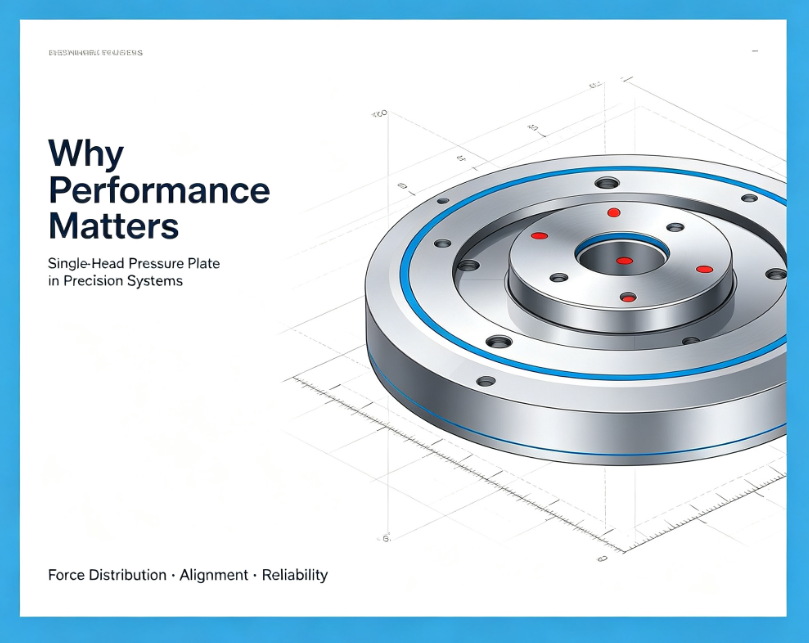
Table of Contents
1. Introduction
2. What Exactly Is a Single-head Pressure Plate?
3. The Critical Role of the Single-head Pressure Plate in Automotive AC Systems
4. Material Matters: Why Aluminum Alloy Dominates
5. Precision Machining: Where the Magic Happens
6. Surface Finish and What It Actually Means
7. Quality Standards and Why They Matter
8. Real-World Application: A Case Study
9. Common Questions About Single-head Pressure Plates
10. Conclusion
Introduction
Let me start with something I see far too often in our industry. Engineers and procurement teams spend weeks agonizing over compressor selection, refrigerant types, and system architecture—but they treat the humble single-head pressure plate as an afterthought. It's just a connecting piece, right? A simple mechanical component that doesn't really impact performance?
Wrong.
I've been working with automotive HVAC systems for over a decade, and if there's one thing I've learned, it's that the single-head pressure plate is where the rubber meets the road—quite literally. This small, precision-machined aluminum component carries the entire mechanical load of the compressor's pressure transfer. Get it wrong, and you're looking at refrigerant leaks, premature compressor failure, and warranty claims that could have been avoided.
The global automotive pressure plate market was valued at approximately $4.43 billion in 2024 and is projected to reach $6.2 billion by 2035. That's not just growth—that's a signal that the industry is finally waking up to what matters.
So let's talk about why single-head pressure plate performance actually matters, and why you should care.
What Exactly Is a Single-head Pressure Plate?
Before we dive into the technical weeds, let's get our definitions straight.
A single-head pressure plate is a precision-machined aluminum component used in automotive air conditioning compressors—specifically in swash plate-type compressor designs. It serves as the interface between the compressor's rotating assembly and the refrigerant piping system.
In a single-headed swash plate compressor, the compressor has a cylinder block with a housing that encloses the swash plate chamber. The single-head pressure plate connects the pipeline to the compressor body, ensuring leak-free refrigerant transfer while withstanding the significant pressure fluctuations that occur during normal AC operation.
Think of it this way: if the compressor is the heart of the AC system, the single-head pressure plate is the valve connecting that heart to the arteries. It's small, but absolutely essential.
You'll find these components in virtually every modern vehicle with air conditioning—passenger cars, commercial trucks, and increasingly, electric vehicles where thermal management is even more critical.
The Critical Role of the Single-head Pressure Plate in Automotive AC Systems
Here's where things get interesting.
The single-head pressure plate doesn't just sit there looking pretty. It performs several critical functions:
First, it provides a secure, leak-proof connection between the compressor and the refrigerant lines. The system operates under significant pressure—typically 8 to 15 bar on the high-pressure side and around 2 bar on the low-pressure side. Any leakage here means refrigerant loss, reduced cooling capacity, and eventual system failure.
Second, it must withstand constant vibration. Your average vehicle engine compartment is a hostile environment—temperature swings from sub-zero to well over 100°C, constant mechanical vibration, and exposure to road contaminants. The single-head pressure plate has to hold up through all of it.
Third, it facilitates the actual pressure transfer. In a swash plate compressor, the rotary motion of the swash plate is converted into the linear motion of pistons for refrigerant compression. The single-head pressure plate is integral to this pressure transfer mechanism.
What I find fascinating is how the design has evolved. Early compressors used steel components, but the demand for weight reduction in automotive applications has progressively pushed manufacturers toward aluminum alloys. The single-head pressure plate is now almost exclusively manufactured from aluminum—and for good reason.
Material Matters: Why Aluminum Alloy Dominates
This is where a lot of people get confused, so let me clear it up.
Not all aluminum is created equal. When we're talking about single-head pressure plate manufacturing, the material choice matters enormously.
The two most common alloys you'll encounter are 6061 and 7075 aluminum.
6061 aluminum alloy is the workhorse of the industry. It's a precipitation-hardened alloy that demonstrates good mechanical properties, excellent weldability, and strong corrosion resistance. In T6 temper, 6061 achieves a yield strength of approximately 327 MPa and tensile strength of around 362 MPa. Its density is roughly 2.7 g/cm³.
7075 aluminum alloy is the overachiever. Originally designed for aircraft frames, it offers tensile strength up to 572 MPa—comparable to many steels. It's stronger, but also more expensive and slightly more difficult to machine.
So which one should you choose for your single-head pressure plate?
For most automotive applications, 6061-T6 is the sweet spot. It provides excellent strength-to-weight ratio, good machinability, and sufficient corrosion resistance. 7075 is typically reserved for high-performance or heavy-duty applications where the additional strength justifies the cost premium.
I've seen manufacturers try to cut corners by using lower-grade aluminum or recycled material with inconsistent properties. Don't do this. The single-head pressure plate experiences cyclic loading, thermal stress, and constant vibration. Material fatigue is a real concern, and using substandard material is asking for trouble.
Precision Machining: Where the Magic Happens
This is where the single-head pressure plate goes from a hunk of metal to a precision component.
Modern single-head pressure plate manufacturing relies on CNC (Computer Numerical Control) machining. And when I say precision, I mean precision.
Typical dimensional tolerances for aluminum precision machining reach ±0.01 mm. In automotive applications, some critical features are held to even tighter tolerances—as small as ±0.005 mm.
Why does this matter?
The single-head pressure plate connects to the compressor via threaded fittings. These threads need to seal perfectly under pressure. If the threads are even slightly off-spec, you'll get leaks. If the mounting surfaces aren't perfectly flat, you'll get uneven stress distribution that can lead to premature failure.
The machining process typically involves:
Rough cutting to establish the basic shape
Precision milling for critical surfaces
Thread cutting for AN or other standard fittings
Final finishing to achieve the required surface finish
One thing I want to emphasize: the quality of the CNC equipment matters. The best single-head pressure plate manufacturers use high-end machines—like Japanese Brother CNC units—that can maintain consistent accuracy across millions of parts. It's not just about having a CNC machine; it's about having the right CNC machine, properly maintained and operated by skilled technicians.
Surface Finish and What It Actually Means
You'll see specifications like "Ra0.4μm" in single-head pressure plate datasheets. But what does that actually mean?
Ra stands for Roughness Average—it's a measure of the surface's microscopic irregularities. Lower numbers mean smoother surfaces.
Ra0.4 denotes an exceptionally smooth surface finish. To put this in perspective, typical CNC machined aluminum parts achieve Ra0.4 to Ra1.6 μm. Achieving Ra0.4 requires meticulous machining with precise toolpaths, optimal cutting speeds, and carefully tuned parameters.
Why does surface finish matter for a single-head pressure plate?
First, sealing. A smoother surface means better sealing against O-rings and gaskets. Rough surfaces create leak paths.
Second, fatigue resistance. Surface irregularities act as stress concentrators. Under cyclic loading, cracks can initiate at these points. A smoother surface reduces this risk.
Third, corrosion resistance. Smoother surfaces are less prone to pitting and corrosion initiation.
Is Ra0.4 always necessary? Not always. For some applications, Ra0.8 provides a reasonable balance between precision and cost. But for critical sealing surfaces in high-pressure refrigerant systems, Ra0.4 is the gold standard.
Quality Standards and Why They Matter
If you're sourcing single-head pressure plates, you need to understand the quality standards that apply.
IATF 16949:2016 is the core quality management standard developed specifically for the automotive industry. It replaced ISO/TS 16949 and reflects higher expectations on process control, risk management, and supply chain integration.
The standard is fully aligned with ISO 9001:2015 and incorporates risk-based thinking. It applies to a single production site and outlines requirements for product development, manufacturing, and assembly.
What does this mean for you?
An IATF 16949:2016 certified supplier has demonstrated:
Robust quality management systems
Effective process control
Risk management capabilities
Continuous improvement processes
Supply chain integration
I cannot stress this enough: do not buy single-head pressure plates from non-certified suppliers. The certification isn't just paperwork—it's evidence that the manufacturer takes quality seriously and has the systems in place to consistently deliver conforming products.
The IATF has been revising the standard (Revision 2 was announced in October 2024), so ensure your supplier stays current with the latest requirements.
Real-World Application: A Case Study
Let me share a real example that illustrates why single-head pressure plate quality matters.
A major commercial vehicle OEM (let's call them "TruckCo") was experiencing an alarming rate of AC compressor failures in their heavy-duty truck line. The failure mode was consistent: refrigerant leakage at the compressor connection point, followed by compressor seizure.
The root cause? Poor-quality single-head pressure plates from a low-cost supplier.
The plates had several issues:
Inconsistent thread accuracy causing improper sealing
Surface roughness exceeding Ra1.6μm, allowing refrigerant to seep past the O-ring
Material inconsistencies leading to stress corrosion cracking
The cost of these failures was staggering. Each compressor replacement cost over $800 in parts alone, plus labor and vehicle downtime. TruckCo was looking at millions in warranty claims.
The solution? Switching to a certified manufacturer that:
Used 6061-T6 aluminum with documented material certifications
Maintained ±0.01mm tolerances on critical dimensions
Achieved Ra0.4μm surface finish on sealing surfaces
Held IATF 16949:2016 certification
The result? Compressor failure rates dropped by over 90%. The single-head pressure plate—that "minor" component—turned out to be the difference between a reliable AC system and a warranty nightmare.
Common Questions About Single-head Pressure Plates
What's the difference between a single-head and double-head pressure plate?
A single-head pressure plate connects to one pipeline, while a double-head version connects to two. Single-head designs are more common in smaller compressors and simpler system architectures.
What thread standard do single-head pressure plates use?
Most use AN (Army-Navy) fittings with UNJF threads. AN fittings use a modified UNF thread form with a larger root radius for improved fatigue strength. AN6 fittings, for example, have a 9/16-18 thread.
How do I know if my single-head pressure plate needs replacement?
Common signs include:
Refrigerant leaks at the compressor connection
Visible corrosion or pitting
Thread damage or galling
AC system pressure loss
What's the typical lifespan of a single-head pressure plate?
In a properly maintained system, the pressure plate should last the lifetime of the compressor—typically 8-10 years or more. However, poor installation, system contamination, or extreme operating conditions can shorten this significantly.
Can single-head pressure plates be repaired?
Generally, no. The precision surfaces and threads make repair impractical. Replacement is the standard approach.
Why is aluminum preferred over steel for pressure plates?
Weight reduction is the primary driver. Aluminum also offers excellent corrosion resistance and good thermal conductivity—both beneficial in AC applications.
Conclusion
The single-head pressure plate might not be the most glamorous component in an automotive AC system, but it's absolutely essential. It's the connection point where pressure transfers from compressor to pipeline—and if that connection fails, the entire system fails.
What have we learned?
First, material matters. 6061-T6 aluminum offers the best balance of strength, machinability, and corrosion resistance for most applications.
Second, precision is non-negotiable. Tolerances of ±0.01mm and surface finishes of Ra0.4μm aren't just specifications—they're requirements for reliable operation.
Third, certification proves capability. IATF 16949:2016 certification indicates a manufacturer has the systems and processes to consistently deliver quality.
And finally, the cost of poor quality is far higher than the cost of good quality. The TruckCo case study demonstrates that saving a few cents on a pressure plate can cost millions in warranty claims.
When you're evaluating single-head pressure plate suppliers, look beyond the price tag. Ask about materials, tolerances, surface finish, and certification. Request test reports. Visit the facility if you can. The extra effort upfront will pay dividends in reliability and peace of mind.
Because in the end, a single-head pressure plate isn't just a component—it's the difference between a system that works and a system that fails.