August 11, 2026
Professional High-tech Manufacturer of Automotive Air Conditioning Radiators and Spare Parts
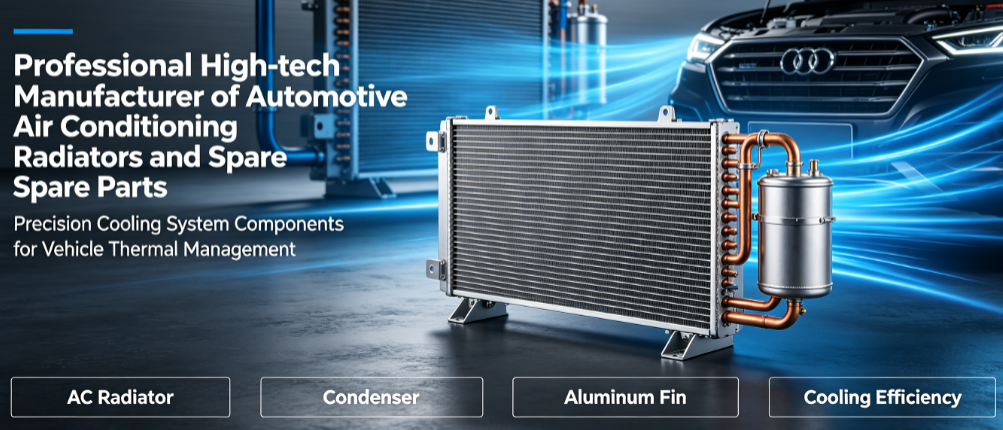
Table of Contents
1. Introduction
2. Main Product Portfolio
3. Core Performance Requirements for Automotive Air Conditioning Heat Exchange Components
4. Key Manufacturing Advantages of Professional High-tech Production
5. Common Hidden Risks of Low-grade Automotive Air Conditioning Radiators & Accessories
6. Data Comparison: Ordinary Aftermarket Parts VS High-tech OEM-grade Automotive Air Conditioning Radiator Components
7. Strict Whole-process Automotive-grade Quality Control System
8. Typical Application Scenarios
9. Custom Radiator & Spare Parts Development Service
10. Conclusion
11. Industry FAQ
1. Introduction
Vehicle thermal management systems determine driving comfort, energy consumption and stable operation of new energy vehicle power components. Ordinary aftermarket air conditioning radiators and spare parts often suffer insufficient heat dissipation efficiency, poor pressure resistance, easy internal leakage and rapid corrosion, leading to air conditioning cooling attenuation, abnormal system pressure and frequent after-sales failures.
We are a professional high-tech manufacturer specializing in automotive air conditioning radiators and supporting spare parts. Integrating independent heat exchange structure R&D, precision fin forming, vacuum brazing, surface anti-corrosion treatment and performance testing, we produce condensers, evaporators, heater cores and matching auxiliary components. Optimized flow channel layout, lightweight aluminum alloy material and anti-corrosion coating technology achieve high heat exchange efficiency, vibration fatigue resistance and long service life. Our products serve passenger vehicles, new energy vehicles, commercial vehicles and engineering machinery. We support OEM mass supply, aftermarket batch delivery and customized development for special vehicle models, meeting the demands of auto OEMs, tier-one suppliers, auto parts distributors and engineering machinery manufacturers.
This article introduces product classification, heat exchange design standards, anti-corrosion process specifications and engineering selection guidelines, providing reliable technical procurement reference for vehicle manufacturers, auto parts trading companies and thermal system design teams.
Core Industry Keywords: automotive air conditioning radiator, auto condenser, evaporator, heater core, vehicle thermal management component, aluminum heat exchanger, vacuum brazed radiator, new energy vehicle air conditioning parts, automotive AC spare parts, lightweight heat exchange assembly
2. Main Product Portfolio
2.1 Automotive Air Conditioning Core Heat Exchange Components
· Condensers: parallel flow aluminum condensers for passenger cars, new energy vehicles and commercial vehicles
· Evaporators: laminated evaporators, fin evaporators for vehicle air conditioning systems
· Heater cores: aluminum heater cores for cabin heating systems
· Combined integrated heat exchangers for new energy vehicle thermal management modules
2.2 Supporting Air Conditioning Spare Parts
· Liquid storage dryers, accumulators
· Expansion valves, pipeline connection assemblies, aluminum connecting pipes
· Mounting brackets, shock absorption gaskets, sealing assemblies
· Custom flow channel joints, anti-vibration fixing components
2.3 Material & Process Customization
Main material: high-quality aluminum alloy; Process options: vacuum brazing, hydrophilic coating, anti-corrosion surface treatment, lightweight thinning structural optimization; Customizable parameters: heat exchange area, pipeline layout, interface size, mounting hole position, overall dimension according to vehicle packaging space.
3. Core Performance Requirements for Automotive Air Conditioning Heat Exchange Components
3.1 Efficient & Stable Heat Exchange Performance
Reasonable fin and flow channel structure ensures sustained heat exchange efficiency; avoid performance attenuation after long-term operation.
3.2 High Pressure & Leakage Resistance
Withstand refrigerant system pressure fluctuation; prevent micro leakage caused by vibration and pressure impact.
3.3 Vibration Fatigue Durability
Adapt to continuous road vibration; avoid cracking at brazed joints and flow channels.
3.4 Environmental Anti-corrosion Capacity
Resist salt spray, rainwater splash and road dust erosion for chassis-mounted radiators.
3.5 Lightweight Packaging Adaptability
Thin-wall aluminum structure design matches vehicle lightweight layout without sacrificing strength.
3.6 Clean Internal Flow Channel
Less residual impurities after manufacturing; avoid expansion valve blockage and refrigerant circuit contamination.
4. Key Manufacturing Advantages of Professional High-tech Production
4.1 Independent Thermal Structure R&D Capability
Carry out heat exchange simulation to optimize fin density, flow path arrangement and pressure drop balance.
4.2 Mature Vacuum Brazing Technology
Precise temperature control in brazing furnace ensures uniform solder joint formation and stable joint strength.
4.3 Targeted Anti-corrosion Surface Treatment
Multi-layer protective coating improves salt spray resistance, adapting to coastal and harsh road conditions.
4.4 Strict Lightweight Structure Optimization
Reduce overall weight while guaranteeing pressure resistance and fatigue performance, matching NEV lightweight trend.
4.5 Complete Offline Performance Testing
Air tightness test, heat exchange efficiency test, vibration ageing and salt spray corrosion simulation available in-house.
4.6 Flexible Order Adaptability
Support OEM mass standardized production and non-standard customized development for special vehicle models.
5. Common Hidden Risks of Low-grade Automotive Air Conditioning Radiators & Accessories
5.1 Insufficient Heat Dissipation Capacity
Unoptimized fin structure leads to poor cooling effect, air conditioning output drops in high-temperature environment.
5.2 Hidden Internal & External Leakage
Poor brazing quality causes slow refrigerant loss; air conditioning gradually loses cooling performance.
5.3 Weak Anti-corrosion Performance
Lack of effective protective coating; rapid corrosion in humid and salt spray environments leading to early scrapping.
5.4 Poor Vibration Resistance
Brazed joints crack under long-term driving vibration, triggering sudden leakage failure.
5.5 Unclean Internal Pipeline
Residual welding slag and impurities easily block expansion valves, causing system failure.
5.6 Dimensional Inconsistency
Large tolerance fluctuation leads to difficult assembly, mismatched pipeline interfaces.
6. Data Comparison: Ordinary Aftermarket Parts VS High-tech OEM-grade Automotive Air Conditioning Radiator Components
The table below summarizes test data collected from passenger vehicle and new energy thermal management projects.
表格
Inspection Item | Ordinary Aftermarket Radiator Parts | High-tech OEM-grade Automotive Air Conditioning Radiator Components | Vehicle Engineering Requirement |
Heat exchange efficiency retention rate after ageing | Obvious decline | Maintain stable performance | Consistent air conditioning cooling effect |
Air tightness failure probability after vibration cycle test | High | Extremely low | Prevent refrigerant leakage |
Salt spray resistance duration | 240 ~ 480 h | ≥800 ~ 1000 h (anti-corrosion coated) | Adapt to complex road environment |
Brazing joint fatigue cycle life | Short | Long service cycle under alternating vibration | Avoid sudden leakage on the road |
Internal pipeline cleanliness | Easy residual impurities | Strict cleaning process | Prevent expansion valve blockage |
Dimensional interchangeability | Noticeable tolerance fluctuation | Tightly controlled machining tolerance | Smooth assembly for mass production |
Data clearly demonstrates that high-tech OEM-grade automotive air conditioning radiators and spare parts effectively reduce air conditioning system failures and extend service life for passenger vehicles, new energy vehicles and engineering machinery.
7. Strict Whole-process Automotive-grade Quality Control System
7.1 Raw Material Incoming Inspection
Verify aluminum alloy sheet hardness, foil material quality, solder composition and coating raw material performance.
7.2 Stamping & Forming Process Monitoring
Control fin forming precision, flow channel flatness and component dimensional consistency.
7.3 Vacuum Brazing Process Control
Furnace temperature curve management; sampling inspection of solder joint penetration and strength.
7.4 Cleaning & Surface Treatment Inspection
Check internal cleanliness, coating uniformity and adhesion after anti-corrosion treatment.
7.5 Batch Performance Comprehensive Testing
Air tightness pressure test, heat exchange efficiency spot check, vibration ageing and salt spray test.
7.6 Finished Product Appearance & Dimension Final Audit
Screen for surface deformation, brazing defects and dimensional deviation before packaging.
7.7 Complete Batch Traceability
Raw material batches, process parameters and test records archived for automotive component lifecycle tracking.
8. Typical Industrial Application Scenarios
New Energy Passenger Vehicles
· Vehicle air conditioning condenser, evaporator and heater core
· Thermal management system auxiliary heat exchange components for battery and electric drive
Traditional Fuel Passenger Cars
· Cabin air conditioning complete heat exchange assembly
· Supporting liquid storage dryer, pipeline connection accessories
Commercial Vehicles & Buses
· Large bus, truck air conditioning condensers and evaporators
· Engineering machinery, agricultural vehicle cab air conditioning radiators
Aftermarket Replacement Market
· Universal and model-specific air conditioning radiator spare parts for vehicle maintenance service
9. Custom Radiator & Spare Parts Development Service
We develop customized air conditioning heat exchangers and supporting spare parts according to vehicle layout drawings, heat load parameters, installation space and environmental conditions. Adjust heat exchange area, flow channel structure, interface specification and anti-corrosion scheme. Support prototype small-batch trial production and mass continuous manufacturing. All batches can provide performance test reports and material certificates for OEM project audit and market access.
Engineering team conducts thermal simulation and bench performance verification to optimize structural design before formal mass production.
10. Conclusion
Automotive air conditioning radiators are core heat exchange components of vehicle thermal management systems. Low-grade aftermarket radiators and spare parts easily cause insufficient cooling capacity, refrigerant leakage and premature corrosion failure.
Professional high-tech manufacturers of automotive air conditioning radiators and spare parts rely on independent thermal design, mature vacuum brazing and multi-layer anti-corrosion treatment. Stable heat exchange efficiency, vibration fatigue resistance and leakage-proof performance satisfy long-term operation requirements of passenger vehicles, new energy vehicles and commercial machinery.
Auto OEMs and parts distributors are recommended to select heat exchanger manufacturers with complete thermal simulation, vacuum brazing and automotive-grade testing capabilities instead of purchasing low-cost general aftermarket components.
11. Industry FAQ
Q1: What are the differences between parallel flow condensers and traditional condensers? A: Parallel flow structure features higher heat exchange efficiency, lightweight volume, widely adopted for new energy vehicles and modern passenger cars.
Q2: Can radiators be customized for new energy vehicle integrated thermal management systems? A: Yes. We can design integrated multi-flow heat exchangers that simultaneously process air conditioning refrigerant and cooling liquid.
Q3: What anti-corrosion treatment is applied for coastal high-humidity areas? A: Multi-layer hydrophilic anti-corrosion coating is adopted to improve salt spray resistance and delay surface oxidation.
Q4: What main tests will be carried out for finished radiators? A: Air tightness pressure test, heat exchange efficiency test, vibration fatigue test and salt spray corrosion test.
Q5: Can both OEM mass supply and aftermarket customized spare parts be supported? A: We support vehicle factory OEM matching production and aftermarket model-specific replacement parts development simultaneously.