July 31, 2026
Aluminum Automotive AC Parts: Why Lightweight Materials Are Preferred
Introduction
For decades, copper was the default material for automotive air conditioning systems. It was ductile, easy to join, and offered excellent heat transfer properties. But the automotive industry has undergone a fundamental shift. Today, virtually all modern automotive air conditioning systems use all-aluminum heat exchanger units.
This transition was not driven by a single factor. It is the result of converging pressures: the demand for lighter vehicles to improve fuel efficiency and EV range, the rising cost of copper, the need for better corrosion resistance, and the push for more sustainable, recyclable materials. For procurement professionals and engineers, understanding why aluminum has become the preferred material is essential for making informed sourcing decisions.
The Weight Advantage: Aluminum’s Core Value Proposition
Weight reduction is the single most important driver behind aluminum’s adoption in automotive AC systems. A key advantage of aluminum is its lightweight nature, which is critical for maximizing battery range and overall vehicle efficiency. Every kilogram of aluminum used in a car reduces the overall weight of the vehicle by as much as two times.
The weight savings are substantial. Aluminum is up to 70% lighter than copper. For applications where weight is a concern, this difference is transformative. A pound of aluminum yields nearly three times as many parts as a pound of copper, meaning manufacturers can produce significantly more components with the same material weight.
In the context of electric vehicles, this weight reduction directly translates to extended driving range. When used in electric buses, aluminum micro-channel heat exchangers can help increase the vehicle‘s range. For internal combustion vehicles, lighter weight means improved fuel efficiency and reduced emissions.
Cost-Effectiveness: Beyond the Price of Raw Materials
Aluminum is not only lighter—it is also more cost-effective than copper. Copper has historically been significantly more expensive, with the copper-to-aluminum ratio having a long-run average of 3.7, meaning a pound of copper is traditionally 3.7 times more expensive than aluminum.
The cost advantage extends beyond raw material prices. There is a potential for saving as much as 35% by using aluminum instead of copper. In HVAC and automotive applications, aluminum is now used in approximately 40% of global units, double the level from five to six years ago.
However, the transition to aluminum is not a simple swap. As industry experts note, transitioning to aluminum is a reengineering process that requires redesigning components to leverage aluminum‘s properties—for example, replacing copper tubes with micro-channel extrusions. But once manufacturers make the transition, they typically do not return to copper.
Corrosion Resistance: A Hidden Advantage
One of the most significant technical advantages of aluminum is its immunity to formicary corrosion—a type of premature failure that affects copper in air conditioning units. Formicary corrosion is caused by a chemical reaction requiring oxygen, water, and organic acid, often induced by common lubricating oils. It has been a long-standing problem with copper tubing for HVAC applications. This type of corrosion only occurs in copper-based alloys—aluminum is immune to it.
The impact is substantial. It is estimated that 10% of indoor heat exchangers fail prematurely due to formicary corrosion. By replacing copper with aluminum, manufacturers achieve a dual benefit: lower initial raw material costs and a reduction in warranty costs.
An all-aluminum system also improves the galvanic balance of the materials, giving better corrosion resistance and less heat transfer performance degradation during its service life.
Heat Transfer Performance: The Thermal Conductivity Myth
A common misconception is that aluminum’s lower thermal conductivity—approximately half that of copper—makes it inferior for heat exchange. In practice, this difference is entirely negligible for heat transfer performance.
The reason is that heat exchanger performance is dominated by the airside interface conductivity. The actual, measurable performance difference between copper and aluminum heat exchangers is limited. What matters more is the design of the heat exchanger itself.
Micro-channel heat exchangers, which are made possible by aluminum’s extrudability, offer superior heat exchange efficiency. Compared to traditional copper tube and fin heat exchangers, they improve by about 30% in the same volume. This is attributed to their unique heat exchange structure, which significantly increases the heat exchange area.
Key Aluminum Components in Automotive AC Systems
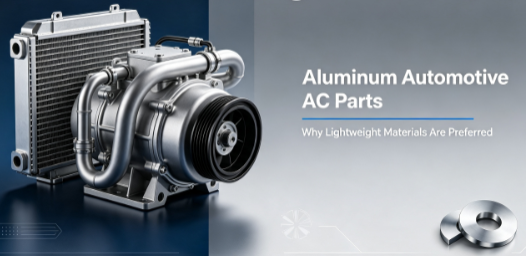
The cooling unit of an automobile air conditioning system consists of an evaporator, compressor, condenser, and expansion valve. Aluminum is now used across virtually all of these components:
Component | Aluminum Application |
Condenser | Brazed aluminum condensers with micro-channel tubes; lighter, smaller, and more efficient than copper alternatives |
Evaporator | Aluminum tube and fin designs; often with brazed aluminum construction |
Piping and Tubing | Aluminum alloy 6063 tubing for refrigerant lines; approximately 30% lighter than steel alternatives |
Heat Exchangers | All-aluminum construction with micro-channel technology for maximum efficiency |
Manufacturing Innovations: Micro-Channel Technology
The shift to aluminum has been enabled by significant advances in manufacturing technology. Micro-channel aluminum tubes are a key technology for next-generation automotive air conditioning. These tubes are made of aluminum alloy with a very thin wall thickness and a large number of microchannels inside.
This unique structure provides several advantages over traditional copper tubes, including higher heat transfer efficiency, lighter weight, and better corrosion resistance. Micro-channel technology was first developed in the 1990s and initially used only in high-end luxury cars, but has since become increasingly popular in mainstream vehicles.
The production of micro-channel aluminum tubes is technically challenging, requiring ultra-high extrusion ratios of 400 times or more, and dimensional tolerances as tight as ±0.01 to ±0.02mm.
Sustainability: Infinite Recyclability
Aluminum is infinitely recyclable and not prone to scarcity or fluctuations in commodity prices. This makes it a more sustainable choice than copper, particularly as the global energy transition drives exponential growth in demand for conductive materials.
Micro-channel heat exchangers are made with a core that is 100% aluminum, which is easy to recycle. Their small volume also allows for a reduction of up to 60% in refrigerant charging compared to traditional heat exchanger solutions, thereby reducing refrigerant usage and achieving energy savings.
Summary
Factor | Aluminum | Copper |
Weight | Up to 70% lighter; 1 lb yields 3× more parts | Heavier |
Cost | 35% potential savings; lower raw material cost | Significantly more expensive |
Corrosion Resistance | Immune to formicary corrosion | Susceptible to formicary corrosion |
Heat Transfer | Comparable in actual performance; superior with micro-channel design | Higher thermal conductivity but negligible advantage |
Recyclability | Infinitely recyclable | Recyclable but less sustainable |
Manufacturing | Enables micro-channel technology; requires reengineering | Mature, well-understood processes |
Conclusion
The automotive industry’s shift from copper to aluminum in air conditioning systems is not a compromise—it is an upgrade. Aluminum offers the lightweight construction critical for fuel efficiency and EV range, significant cost savings, superior resistance to formicary corrosion, and comparable heat transfer performance when properly engineered.
The transition has been enabled by advances in micro-channel technology and aluminum alloy development, allowing manufacturers to redesign components that are lighter, more efficient, and more durable than their copper predecessors. As the industry continues to prioritize sustainability, weight reduction, and cost optimization, aluminum’s role in automotive AC systems will only grow.